
What to Avoid While Buying an Air Fryer
When buying an air fryer, avoid choosing only by price, basket size, or brand hype. The biggest mistakes are buying the wrong capacity, ignoring counter space, choosing hard-to-clean baskets, skipping safety checks, and paying extra for presets you will not use.
- Avoid tiny baskets for family meals.
- Avoid unknown models with no recall history.
- Avoid baskets that are hard to wash.
- Avoid poor ventilation clearance.
- Avoid paying for unused features.
You want crispy food, faster dinners, and less oil. Then you open 20 air fryer listings and every model sounds perfect.
That is where buyers get stuck. The wrong air fryer does not fail because it cannot cook fries. It fails because it does not fit your real kitchen, real meals, or real cleaning habits.
This guide takes about 12 minutes to read. By the end, you will know what to avoid while buying an air fryer and how to choose one that works beyond the first week.
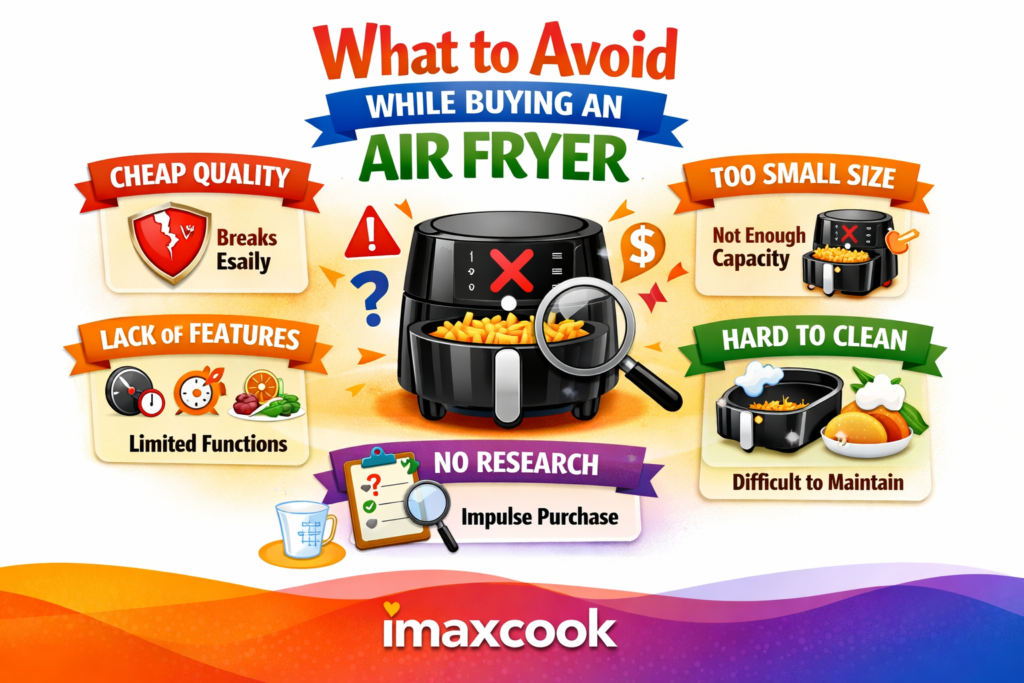
Quick buying rule: Choose an air fryer by food quantity, basket shape, safety record, cleaning effort, and counter clearance before looking at presets, color, or discounts.
1. Avoid Buying the Wrong Air Fryer Size
The wrong air fryer size is the most common buying mistake. A small basket saves space, but it forces batch cooking and turns a quick dinner into a longer job.
Most single people do well with 2 to 4 quarts. Couples usually need 4 to 6 quarts. Families should look closer to 6 quarts or more, especially for chicken, vegetables, frozen snacks, and reheating leftovers.
You might think a bigger air fryer always solves the problem. It does not. A large air fryer takes more counter space, heats a bigger chamber, and can feel clumsy for small portions.
| Household | Best Capacity Range | Avoid This Mistake |
|---|---|---|
| 1 person | 2 to 4 quarts | Buying a bulky family model |
| 2 people | 4 to 6 quarts | Choosing a tiny snack-only basket |
| 3 to 4 people | 6 to 8 quarts | Ignoring batch cooking time |
| 5+ people | 8+ quarts or dual basket | Buying one narrow basket |
Key takeaway: Buy for the largest meal you cook weekly, not the smallest snack you cook daily.
Capacity alone still does not tell the full story. Basket shape matters next because wide food cooks better than stacked food.
2. Avoid Narrow Baskets That Force Food Stacking
A wide air fryer basket usually cooks better than a deep narrow basket. Air fryers need fast hot air circulation around food, and stacked food blocks that airflow.
This matters most for fries, chicken wings, vegetables, fish fillets, and frozen snacks. If food piles up, the lower layer steams while the top layer browns.
That is why two air fryers with the same quart size can perform differently. A wide 5-quart basket can cook more evenly than a tall 6-quart basket with less surface area.
- Choose wide baskets for fries, wings, and vegetables.
- Choose dual baskets for two foods at once.
- Avoid deep baskets if you hate shaking food often.
- Avoid round baskets for square frozen foods.
- Check basket dimensions, not only quart size.
For a deeper look at what an air fryer is best used for, see the main use of an air fryer.
The next issue is less exciting than basket shape, but it decides whether you keep using the appliance.
3. Avoid Air Fryers That Are Hard to Clean
A hard-to-clean air fryer becomes annoying fast. Grease collects around the basket, tray, drawer edges, fan area, and heating element.
Before buying, check whether the basket, crisper plate, and drawer come apart easily. Smooth surfaces, removable trays, and dishwasher-safe parts save more time than fancy presets.
You might think liners solve the cleaning problem. Liners help with crumbs and sticky sauces, but they do not replace washing the basket or wiping the drawer.
Warning: Avoid air fryers with many grooves, exposed seams, or awkward corners inside the basket. Grease hides there and creates smoke during later cooking.
Cleaning also affects safety. Food residue near the heating element can smoke, burn, and affect flavor during the next cook.
IMAGE SUGGESTION: Side-by-side image of an easy-clean removable air fryer basket beside a greasy hard-to-clean basket.
ALT TEXT: What to avoid while buying an air fryer hard to clean basket comparison.
4. Avoid Ignoring Safety Recalls and Brand Transparency
Safety history matters when buying an air fryer. Air fryers use high heat, electrical wiring, plastic housing, fans, baskets, and non-stick coatings in a compact body.
Check the model name and brand before buying, especially from marketplaces with many third-party sellers. The U.S. Consumer Product Safety Commission lists recall notices for appliances, including air fryers with overheating, fire, burn, and laceration hazards.
Look for clear material information, warranty terms, customer support access, and model numbers. Avoid sellers that hide the manufacturer, use unclear product photos, or offer no replacement support.
- Check the exact model number before purchase.
- Search the brand in the CPSC recall database.
- Avoid listings with no warranty details.
- Avoid unknown brands with no support page.
- Save your receipt and model label photo.
The unasked question: Do not only ask, “Which air fryer is best?” Ask, “Can I verify this exact model if something goes wrong?”
Safety also connects to food safety. Raw meat, poultry, seafood, and egg dishes still need proper internal temperatures, even when the air fryer browns the outside quickly.
5. Avoid Buying Based Only on Presets
Presets sound helpful, but they are not the main reason an air fryer cooks well. A preset only saves a time and temperature setting.
Real cooking performance comes from heating power, airflow design, basket shape, temperature accuracy, and how evenly the fan moves air. A model with 12 presets can still cook uneven fries.
You might think more presets mean more meals. Most people use manual time and temperature after the first few weeks because food thickness, portion size, and frozen state change the timing.
Tip: Prioritize manual temperature control, a clear display, and easy buttons before paying extra for preset names like fries, pizza, shrimp, or cake.
Good controls should feel simple. If the panel looks confusing in the store photo, it will feel worse during a busy dinner.
6. Avoid Models That Do Not Fit Your Counter
An air fryer needs more space than its product photo suggests. You need room for the body, handle, drawer pull-out, heat release, and ventilation.
A common mistake is measuring only the appliance width. You should also measure counter depth, cabinet height, outlet location, and space behind the vent.
Air fryers release hot air and steam. Avoid placing one under low cabinets, beside curtains, against a wall, or near plastic containers.
- Measure counter width before buying.
- Measure drawer pull-out space.
- Leave clearance around rear vents.
- Keep the cord away from water.
- Use a heat-safe, stable surface.
If the air fryer stays in a cabinet because it is too bulky, you will use it less. Counter fit is a real buying factor, not a small detail.
Now that the appliance fits the counter, the next filter is what you plan to cook.
7. Avoid Buying an Air Fryer for Foods It Handles Poorly
Air fryers cook many foods well, but they do not cook everything well. Wet batter, loose cheese, large roasts, soups, rice, and high-liquid foods are poor matches.
The appliance works through dry circulating heat. That heat crisps surfaces, but it does not boil grains, hold liquid, or keep loose batter in place.
You might think any “fried” food works. Tempura and beer-battered fish need hot oil to set the batter fast. In an air fryer, wet batter drips before it crisps.
| Food Type | Air Fryer Result | Better Choice |
|---|---|---|
| Frozen fries | Excellent | Air fryer |
| Chicken wings | Excellent | Air fryer |
| Wet batter | Messy and uneven | Deep fryer or pan |
| Rice and grains | Poor | Rice cooker or pot |
| Large whole roast | Uneven | Oven |
Key takeaway: Buy an air fryer for crisping, roasting, reheating, and small-batch cooking, not for replacing every kitchen appliance.
For health-focused cooking comparisons, see how air frying compares with other cooking methods.
8. Avoid Cheap Coatings and Unknown Basket Materials
Basket material matters because the basket touches your food and takes the most wear. Non-stick baskets are convenient, but scratched coatings lose their value.
Look for clear material labeling such as ceramic-coated, stainless steel rack, BPA-free parts, or PFOA-free coating. Avoid vague phrases like “premium coating” without material details.
The FDA explains that acrylamide can form in some plant-based foods during high-temperature cooking, including frying, roasting, and baking. That means air fryer safety depends on both the appliance and your cooking habits.
- Avoid scratched display models.
- Avoid baskets with peeling coating.
- Avoid metal utensils on non-stick baskets.
- Avoid unknown plastics near hot food zones.
- Choose replaceable baskets when available.
For more detail on coating damage, fumes, acrylamide, and safe cooking habits, read the full guide to air fryer health concerns.
The next mistake costs money, not safety.
9. Avoid Paying for Features You Will Not Use
Extra functions can help, but only when they match your cooking routine. Dehydrate, rotisserie, bake, broil, reheat, and dual-zone modes sound useful until they sit unused.
Before buying, list the meals you cook each week. If your real use is fries, vegetables, chicken, and leftovers, you need strong air fry and reheat performance more than a rotisserie cage.
You might think a multi-cooker gives better value. It gives better value only when you use the extra modes often enough to justify the larger size and higher cost.
Best value rule: Pay for capacity, airflow, easy cleaning, safety support, and reliable controls before paying for extra cooking modes.
Accessories follow the same rule. Skewers, racks, liners, cake pans, and pizza trays help only when they fit the basket and match your meals.
10. Avoid Ignoring Food Safety While Shopping
Food safety starts before the first cook. A good air fryer should make it easy to cook food evenly, shake or flip halfway, and check doneness.
The USDA air fryer food safety guidance recommends the same core food safety steps used for other cooking methods: clean, separate, cook, and chill. A food thermometer still matters for meat, poultry, seafood, and egg-based foods.
Choose an air fryer with a basket you can open safely, a handle that feels stable, and enough room to spread raw proteins in a single layer. Crowded meat browns outside while cold spots remain inside.
- Use a thermometer for raw chicken and meat.
- Do not crowd raw proteins.
- Wash baskets after each use.
- Keep raw and cooked foods separate.
- Let the appliance cool before cleaning.
IMAGE SUGGESTION: Home cook checking air fryer chicken with a food thermometer beside a clean basket.
ALT TEXT: What to avoid while buying an air fryer food safety thermometer check.
11. What Most People Get Wrong About Buying an Air Fryer
Most air fryer buying advice starts with brand lists. That skips the harder question: which model fits your kitchen behavior?
The first wrong belief is that bigger always means better. Bigger helps families, but it hurts small kitchens and quick single servings.
The second wrong belief is that a famous brand guarantees the best model. Brand reputation helps, but exact model design, safety support, basket shape, and cleaning access still matter.
The third wrong belief is that an air fryer replaces an oven. It replaces some oven tasks, especially small crisp foods and leftovers. It does not replace large baking trays, wet dishes, soups, or full roasts.
Tip: Read negative reviews before positive reviews. They reveal cleaning problems, basket coating issues, weak handles, loud fans, and poor customer support faster.
Once you correct those beliefs, the buying decision becomes simpler.
12. Air Fryer Buying Decision Block
Use your living situation to narrow the choice. This prevents overbuying and underbuying.
- If you live alone: choose a compact 2 to 4-quart model with easy cleaning.
- If you cook for two: choose a 4 to 6-quart wide basket model.
- If you cook for a family: choose 6 quarts or more, or a dual-basket design.
- If you cook meat often: choose a model with stable temperature control and basket space.
- If you hate cleaning: choose removable, dishwasher-safe parts with fewer grooves.
- If counter space is tight: choose a vertical compact model after measuring clearance.
- If safety is your priority: choose a known brand with clear materials and recall support.
One simple test: If you cannot name three meals you will cook in the air fryer every week, wait before buying the expensive model.
That final pause protects your money more than any sale countdown.
The best air fryer is not the one with the most presets; it is the one that fits your meals, counter space, cleaning habits, and safety expectations.
As air fryers keep adding smart features in 2026, the real value will still come from airflow, basket design, material quality, and support after purchase.
Take two minutes now and measure your counter depth, cabinet height, and weekly meal size before choosing a model.
Frequently Asked Questions
What size air fryer should I avoid buying?
Avoid buying a 2-quart air fryer if you cook full meals for two or more people. That size works for snacks and single servings, but it forces batch cooking for chicken, fries, vegetables, and leftovers. Most couples need at least 4 quarts for daily use.
Are cheap air fryers worth buying?
Cheap air fryers are worth buying only when the brand gives clear material details, warranty support, and stable reviews. Avoid no-name models with unclear coatings, weak handles, poor return policies, or no model number. Low price becomes expensive when the basket peels or the unit fails early.
Should I avoid non-stick air fryer baskets?
You do not need to avoid all non-stick baskets. You should avoid scratched, peeling, or poorly labeled coatings. A good non-stick basket is convenient when handled with silicone or wooden utensils. Stainless steel and ceramic-coated options suit buyers who want fewer coating concerns.
What features are not needed in an air fryer?
Many buyers do not need rotisserie, dehydrate, smart app control, or 12 preset buttons. Manual time and temperature control matter more for daily cooking. Pay for wide basket space, easy cleaning, stable heat, and safety support before paying for features you will rarely touch.
How do I know if an air fryer is safe before buying?
Check the exact model number, brand support page, warranty, material labels, and recall history before buying. Look for stable handles, clear ventilation instructions, and removable parts. Avoid listings with vague product details, copied images, missing manufacturer names, or no customer service information.

I’m passionate about helping home cooks make everyday cooking easier, smarter, and more enjoyable. I share practical kitchen tips, cookware guides, cooking tutorials, and simple recipe inspiration based on real kitchen experience and modern home cooking needs.